Cost per wear: formula, quick table and how to track it


Cost per wear is what you paid for a piece divided by the number of times you've worn it, so $120 jeans worn 60 times cost $2 a wear. The number is only as good as the wear count behind it: count real wears for a season, then use your own counts to estimate before you buy.
The cost per wear formula: price divided by wears
The formula is price ÷ times worn. Use what you actually paid after any discount, with tax and shipping, not the original price on the tag.
Every wear lowers the number. A $90 sweater costs $90 a wear the first time you put it on, $45 after the second wear, $9 after the tenth and $3 after the thirtieth. A piece you've never worn has no cost per wear yet, only a price.
For a quick answer in your head: a piece gets to $1 a wear after as many wears as it cost in dollars. A $150 pair of boots needs 150 wears for $1 a wear, or 75 wears for $2.
For everything else, skip the calculator: find the price on the left and the number of wears across the top.
| Price paid | 5 wears | 10 wears | 30 wears | 50 wears | 100 wears |
|---|---|---|---|---|---|
| $20 | $4.00 | $2.00 | $0.67 | $0.40 | $0.20 |
| $50 | $10.00 | $5.00 | $1.67 | $1.00 | $0.50 |
| $100 | $20.00 | $10.00 | $3.33 | $2.00 | $1.00 |
| $200 | $40.00 | $20.00 | $6.67 | $4.00 | $2.00 |
| $400 | $80.00 | $40.00 | $13.33 | $8.00 | $4.00 |
Prices in between work the same way. A $150 coat sits halfway between the $100 and $200 rows, so 30 wears put it at $5 a wear and 100 wears at $1.50.
Count one wear for each day you leave the house in a piece or spend most of the day in it. Trying it on doesn't count, and a coat worn to work and back is one wear, not two. Whatever rule you pick, use it for every piece, or the numbers won't compare.
Cost per wear examples: a coat, jeans and a party dress
The prices and counts below are made-up examples, rounded so the math is easy to follow; they aren't averages. The math works the same in any currency.
| Piece | Paid | Times worn | Cost per wear |
|---|---|---|---|
| Wool coat, worn three days a week for five winters | $300 | 300 | $1.00 |
| The same wool coat, after two winters | $300 | 120 | $2.50 |
| Cheaper coat that pilled and lost its shape in one winter | $90 | 60 | $1.50 |
| Dark jeans, worn twice a week for two years | $110 | 200 | $0.55 |
| Sale jeans that never fit right | $35 | 4 | $8.75 |
| Party dress, worn to one wedding | $180 | 1 | $180.00 |
| The same dress, after two more parties | $180 | 3 | $60.00 |
| Cashmere sweater saved for best | $150 | 3 | $50.00 |
Paying more lowers the cost per wear only if the piece lasts. After two winters, the wool coat is still at $2.50 a wear, worse than a cheaper coat bought fresh every year at $1.50, and it only pulls ahead in its fourth winter. The quick check is to divide the two prices: $300 ÷ $90 is about 3.3, so the wool coat needs about 3.3 times the wears of the cheaper one just to tie.
A low price doesn't make a piece cheap. The sale jeans cost less than a third of the dark pair and ended up about 16 times as expensive per wear.
Occasion clothes run high by design. A dress bought for one wedding will never get near a dollar a wear, so judge it against what the evening would have cost otherwise: renting, borrowing or a dress you already own. Every re-wear still counts, and two more parties take it from $180 to $60.
The cashmere sweater cost half as much as the wool coat, yet each wear of it cost 50 times as much, because it spends its life in a drawer waiting for an occasion. The fix costs nothing: wear it on ordinary days.
What is a good cost per wear? Lower than your alternative
A good cost per wear is one that's lower than your alternative: a cheaper version you'd replace sooner, renting for one occasion, or wearing something you already own. There's no official benchmark. Worn until they're done, the coats and the dark jeans in the table above land between 55 cents and $1.50 a wear, which shows what everyday pieces can reach, not a target to hit.
The first comparison is the cheaper version. Say you're in a fitting room with a $240 wool coat and an $80 one that fits almost as well. The wool one costs three times as much, so it needs three times the wears to tie, and that depends on two numbers: how often you'd wear it and how many winters it would last.
Take the first from your own history, not from hope: last winter's count for your current coat, or the counts of pieces like the one in your hand. Say your current coat got about 50 wears last winter. If the $80 coat would be done after one winter, it costs $1.60 a wear. The $240 coat gets to the same $1.60 in its third winter and to $0.96 in its fifth. If you already know you'll want a different style in two years, the cheaper coat is the better buy.
The second comparison is your own closet. The pieces you wear most, often jeans, a coat and everyday shoes, show what cost per wear looks like for the way you actually dress. Judge a new piece against the one it would sit next to: if your everyday sneakers are down to 50 cents a wear, a second pair for the same days splits those wears, so each pair takes twice as long to get there. Your highest numbers matter too. They're the pieces to wear more before you buy something that does the same job.
Two more checks before you pay:
- Will you wear it at least 30 times? That's the question behind the #30wears campaign that Livia Firth started at Eco-Age, as she explains in a Refinery29 interview. In the table, 30 wears take a $100 piece to $3.33 a wear. If the honest answer is no, leave it, unless it's an occasion piece you've already weighed against renting.
- Can you name three things you already wear often that it goes with? A piece that works in one outfit can only be worn as often as that outfit.
How to track cost per wear: count a season of real wears
The division is easy; the count is where cost per wear goes wrong. Memory makes a bad counter: the sweater you love feels like it was on all winter, even if it came out twice a month. Real counts can also be low: worldwide, the average number of times a garment is worn before it stops being used fell by 36 percent in 15 years, according to the Ellen MacArthur Foundation's 2017 report A New Textiles Economy.
Four ways to get a real count, from least to most detail:
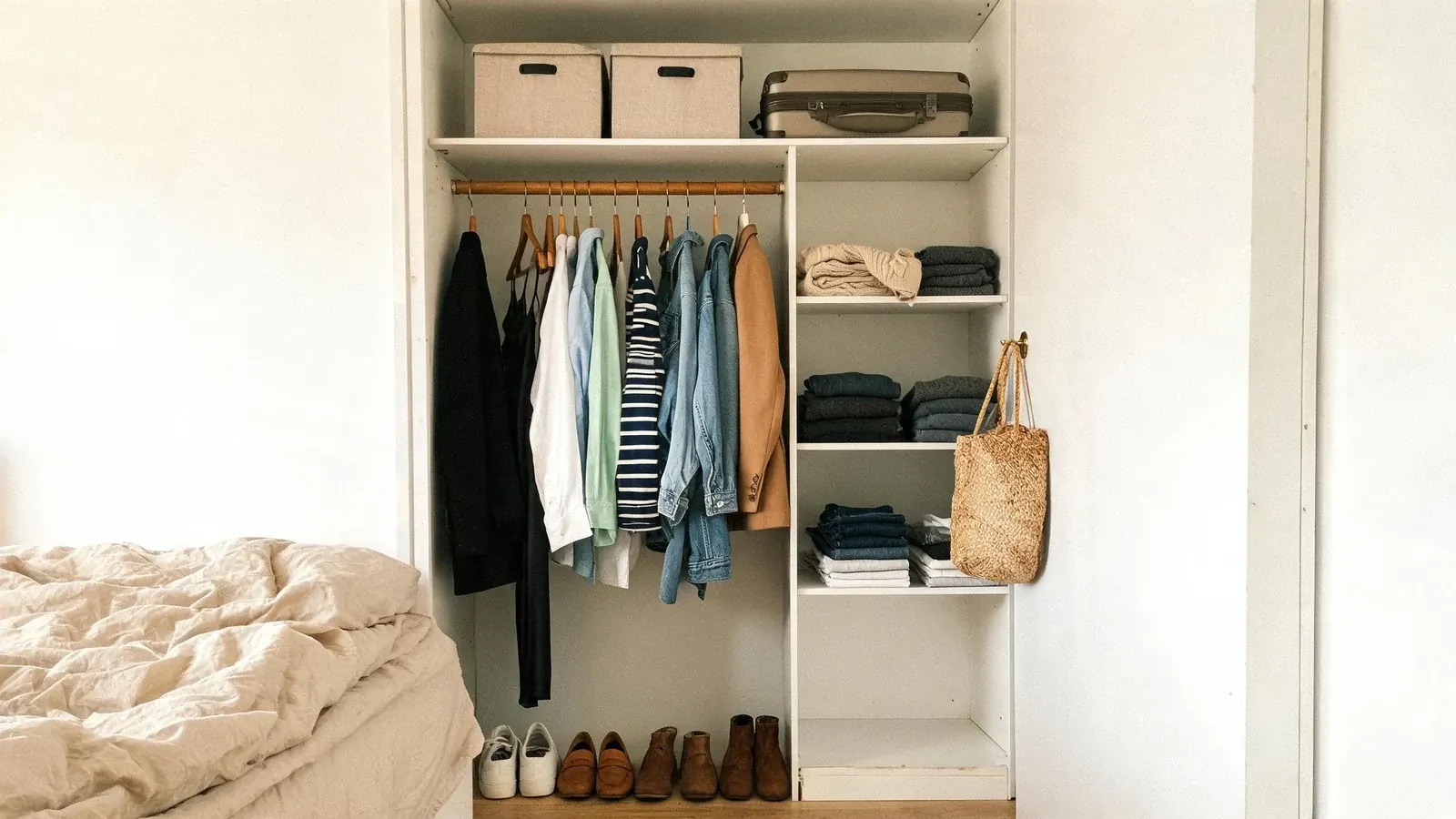
- The hanger trick. Turn every hanger backward at the start of a season, and hang each piece back the normal way after you wear it. It shows what you wear and what you skip, but not how often, and it only covers what hangs. The same trick tells you how to organize your closet by what you actually wear.
- A note or a spreadsheet. Give each piece a line and add a tally mark every time you wear it. In a spreadsheet, put the price in the next column and let it do the division (the columns are below).
- A calendar. Write down what you wore each day, on paper or in your phone's calendar, and count each piece's days at the end of the season. It takes the longest to add up, but it also shows which outfits you repeat.
- An app that logs outfits. In gussy, you mark the outfit you wore on the calendar and every piece in it gets a wear, so each piece shows its count ("Worn 3 times") and the closet can be sorted by Most worn or Forgotten. Add what you paid and each piece shows its cost per wear as well, with your best value per wear picked out on your profile.
A cost per wear spreadsheet needs six columns: piece, category, date bought, price paid, wears and cost per wear. With the price in column D and the wears in column E, type =IF(E2=0,"",D2/E2) in the first cost per wear cell and copy it down. The IF leaves pieces you haven't worn yet blank instead of showing an error. At the end of the season, sort by cost per wear: the top of the list is your best value, the bottom is what to wear more or stop buying.
Give it a full season, about three months, before you judge a piece. If you start when the coats come out, you'll have a winter of real counts before you shop for spring.

What cost per wear leaves out: care, repairs, resale and comfort
Price over wears ignores everything that happens after you buy. A fuller version is (price + care + repairs − resale) ÷ times worn.
Take the wool coat again. Say it's dry-cleaned once a winter for $25, gets new buttons for $15, and sells secondhand for $60 when you're done with it: ($300 + $125 + $15 − $60) ÷ 300 comes to about $1.27 a wear, not $1.00. The cheaper coat went in the washing machine, so it stays at $1.50, and the gap between them shrinks.
Even the fuller formula misses three things:
- Comfort. Every wear counts the same, whether a sweater is soft or itches all day. If you wear something often only because nothing else suits the occasion, that's a gap in your closet, not a good buy.
- Your time. A silk blouse you hand-wash and iron after every wear costs time the formula never sees.
- The cash up front. A coat that works out cheaper over five years can still be the wrong buy if paying for it now leaves you short this month.
Frequently asked questions
How do you calculate cost per wear?
Divide what you paid by the number of times you've worn it: $120 jeans worn 60 times cost $2 a wear. For a fuller figure, add care and repair costs and subtract any resale money first.
Is there a cost per wear calculator?
You don't need one: divide the price by the wears, or read it off the price-by-wears table above. In a spreadsheet, =IF(E2=0,"",D2/E2) works it out for every piece at once.
What is a good cost per wear?
There's no official number. A good cost per wear is lower than your alternative, whether that's a cheaper version you'd replace sooner, renting for one occasion, or wearing something you already own.
Is cost per wear a good way to shop?
It's a good check, not a rule. It works best for things you'd wear often, like coats, jeans and shoes, and it misses comfort, care time and whether the price fits your budget today.
Are expensive clothes worth it?
Only if you'll wear them enough to cover the difference. Divide the two prices: a coat that costs three times as much needs three times the wears, which usually means lasting three times as long.
What is the 30 wears rule?
It comes from the #30wears campaign Livia Firth started at Eco-Age: before you buy something, ask whether you'll wear it at least 30 times, and leave it if the honest answer is no.
How do you track cost per wear?
Keep a wear count for each piece: a tally in a note or a spreadsheet with a price and a wears column, a calendar of what you wore, or an app that logs your outfits. Divide the price by the count.